PROJECT / Design Prototype of the Tri-National Bridge Concept
Design Prototype of the Tri-National Bridge Concept
A symbolic bridge concept for the Germany–Poland–Czech Republic tri-border point, designed with robotic LFAM in mind.
To celebrate 20 years of Poland and the Czech Republic joining the European Union, the Europafest 2024 was held at the Germany–Poland–Czech Republic tri-border point near Zittau. As part of this event, I designed a symbolic bridge concept that could stand right on the tri-border point.
The project began with an open design process. Rather than committing to a single idea, I explored numerous concepts, experimenting with different structural layouts, architectural styles, and symbolic interpretations of unity. Each iteration helped refine both the visual language and the overall message of the bridge.
After evaluating multiple concepts, I decided to base the final design on the existing symbol that represents the connection between Germany, Poland, and the Czech Republic. The challenge was to transform a simple graphic into a three-dimensional architectural concept while preserving its recognizable identity and adapting it into a form that could realistically be envisioned for large-scale additive manufacturing.
The entire digital prototype was developed in Blender, which served as the primary environment throughout the creative process. I used a broad range of Blender's capabilities, including Geometry Nodes for procedural modeling, Shader Nodes for material development, and the built-in rendering engine to produce presentation-quality visualizations. Blender's flexibility enabled rapid iteration and allowed me to explore complex organic geometries that would have been considerably more difficult to achieve using traditional CAD software during the conceptual stage.
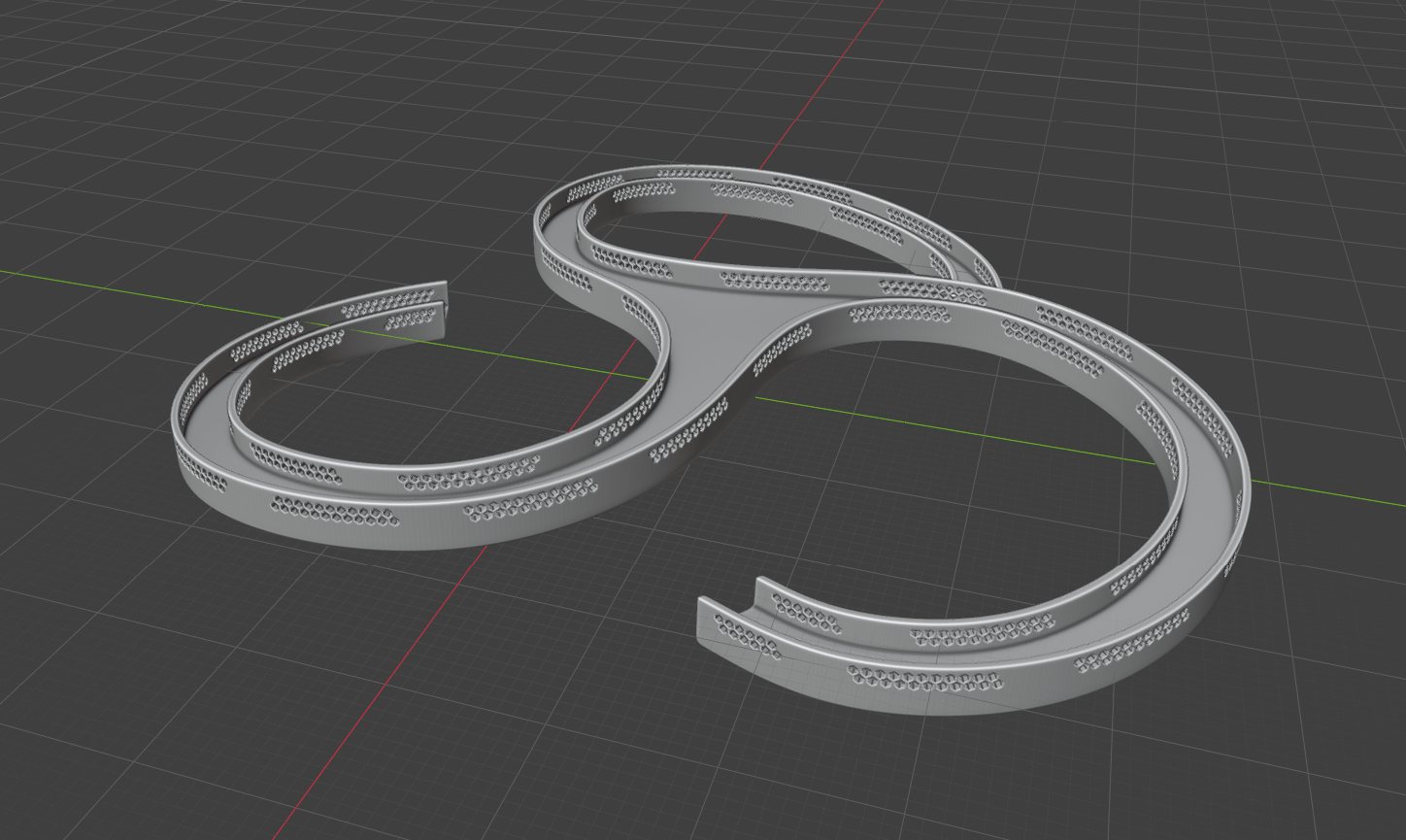
Although the project was a conceptual study, it was developed with robotic LFAM technologies in mind, taking advantage of the geometric freedom offered by additive manufacturing while exploring how engineering and architecture can intersect in future large-scale applications.
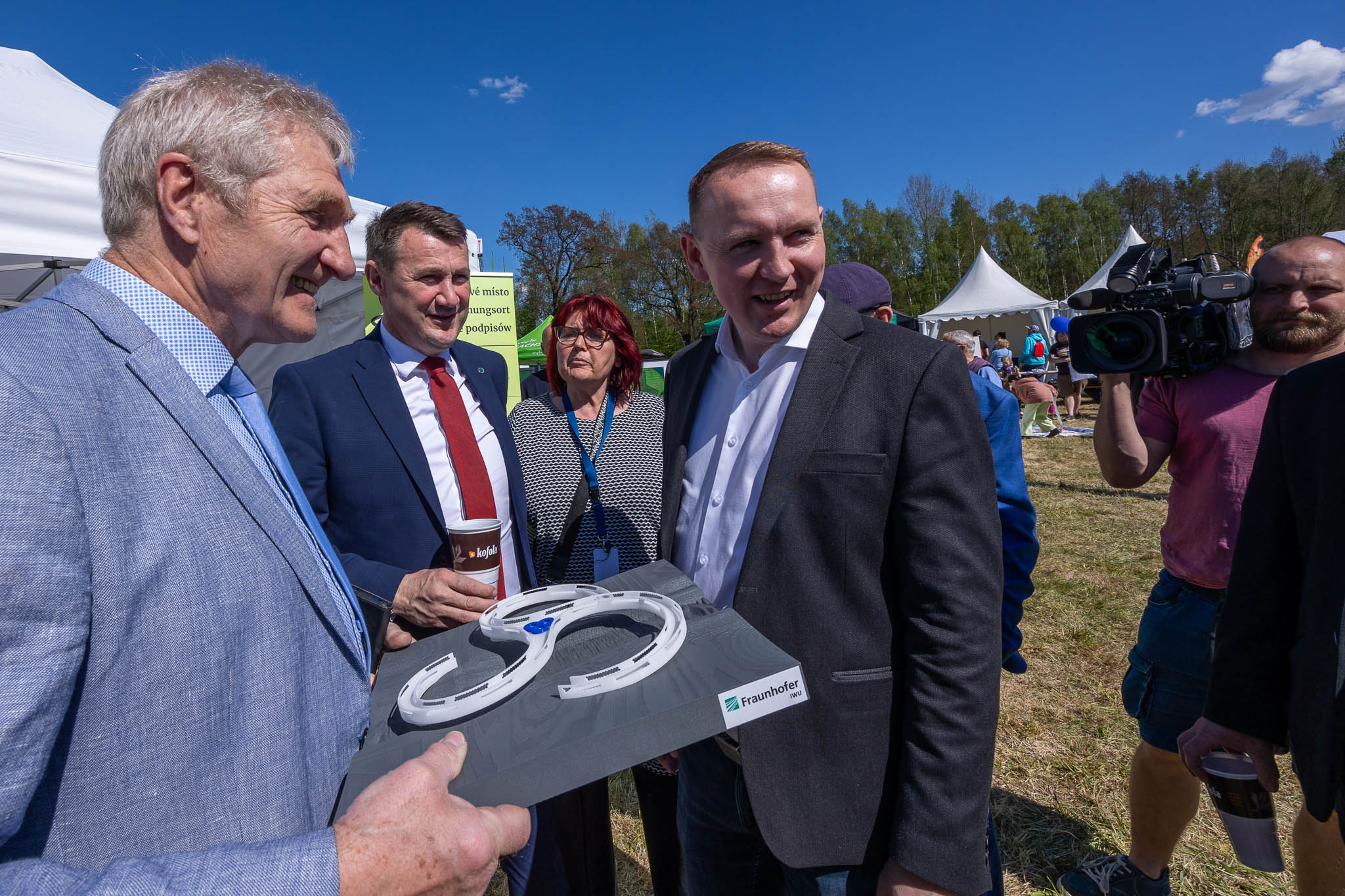
One of the most rewarding moments of the project came during Europafest 2024, where the bridge concept was presented at the tri-border point as part of the official celebrations. Seeing the physical model of my design presented to representatives attending the event was a memorable recognition of the work completed during my internship, and demonstrated how engineering design can contribute to international collaboration and public engagement.
This project remains one of my favorite examples of combining mechanical engineering, computational design, visualization, and additive manufacturing to create a concept that communicates not only technical possibilities but also a symbolic message of cooperation across borders.