PROJECT / Saving Costs on Specialized Slicers: G-code Conversion for Industrial AM
Saving Costs on Specialized Slicers: G-code Conversion for Industrial AM
A Python conversion layer that adapts G-code from desktop FDM slicers for a Sinumerik-controlled robotic large-format additive manufacturing system.
Large-scale additive manufacturing (LSAM) systems based on robotic platforms and industrial controllers often require dedicated software with high licensing costs. Desktop FDM slicers have developed into highly capable platforms with years of community and industrial development behind them, while remaining freely accessible.
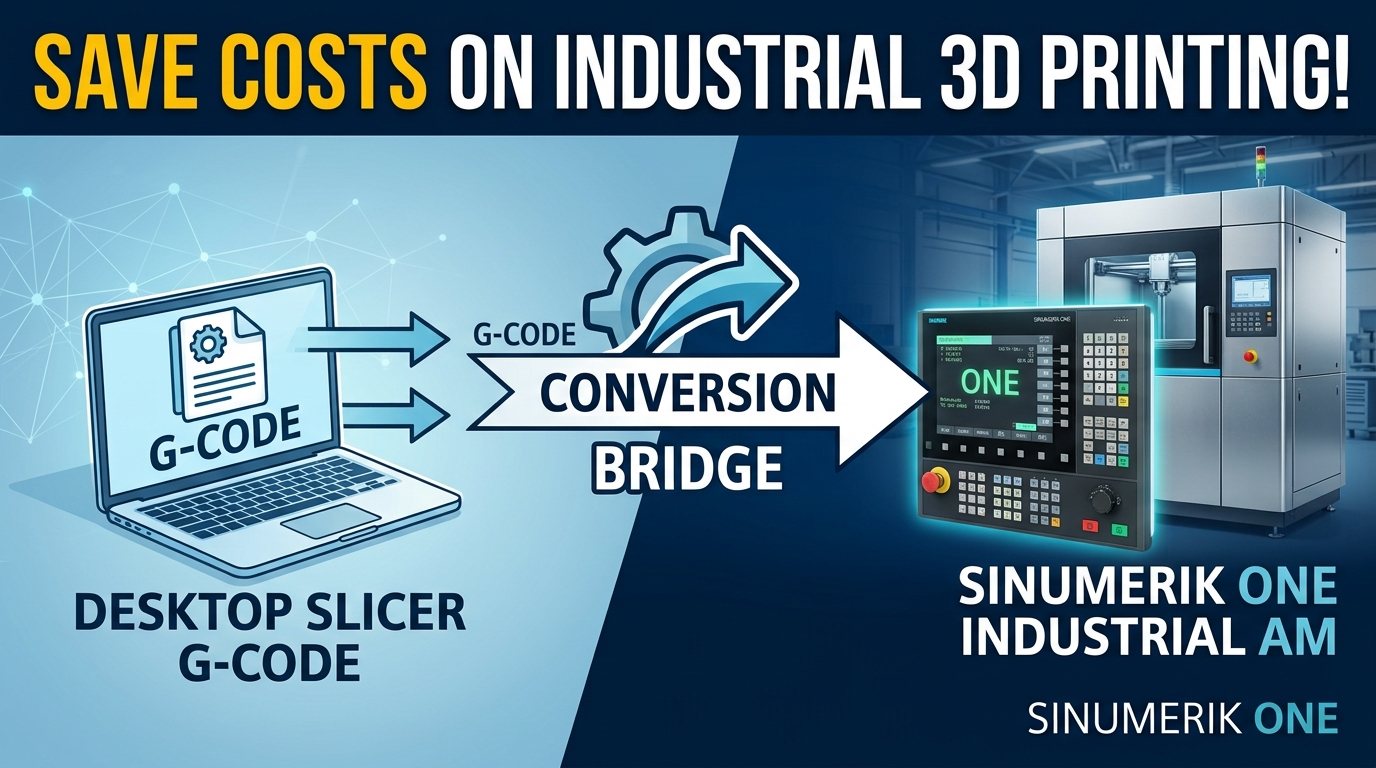
This project addresses that gap by creating a conversion workflow that allows G-code generated by a desktop FDM slicer to be adapted for a Sinumerik-controlled additive manufacturing system. By introducing a Python-based conversion layer between the slicer and the machine controller, the workflow combines the flexibility and accessibility of open slicing software with the capabilities of industrial extrusion equipment.
Modern slicers such as PrusaSlicer offer advanced path-generation strategies, flexible process parameter control, support generation, variable layer heights, custom extrusion widths, and many other features that are continuously improved. However, these tools are primarily designed for conventional 3D printers and cannot directly generate machine programs suitable for industrial additive manufacturing systems.
The approach provides a cost-effective alternative to fully specialized additive manufacturing software solutions, which can represent a significant investment, particularly for research environments, small companies, and experimental development projects. Instead of relying exclusively on expensive proprietary software, this workflow enables the utilization of existing open slicing tools while maintaining compatibility with industrial hardware.
The developed program is designed specifically for a workflow using PrusaSlicer version 2.8.0, a Sinumerik controller, and an industrial extrusion system. The converted machine programs allow the robot-based additive manufacturing system to execute deposition paths generated using the same principles as desktop FDM printing.
However, the program would need to be adapted and modified for each specific machine configuration, as controller commands, extrusion systems, and kinematic setups can vary significantly between different industrial platforms.
Project overview
The developed Python program converts standard G-code generated by PrusaSlicer into a Sinumerik-compatible machine program. The conversion process modifies the generated instructions by removing commands intended for desktop printers and replacing them with commands required by the industrial extrusion system.
The workflow remains similar to conventional FDM printing. The user prepares the geometry, defines manufacturing parameters such as extrusion width and layer height, and generates a toolpath using PrusaSlicer. The resulting G-code is then processed by the converter, which adapts the file for execution on the industrial system.
The current implementation was developed and validated with PrusaSlicer version 2.8.0. Although similar workflows may be possible with other slicing software, additional testing and parameter adjustments would be required to ensure reliable operation.
Conversion principle
The main challenge in adapting desktop slicer output to industrial additive manufacturing is the different approach to extrusion control. Desktop FDM printers typically regulate material deposition by controlling the extruder axis (E-axis), where the amount of filament pushed through the nozzle is directly defined in the G-code. Industrial pellet extrusion systems, however, usually operate using dedicated extrusion controls such as screw speed, pressure regulation, and nozzle valves.
The developed converter therefore separates the movement generation from extrusion control. The slicer remains responsible for generating the deposition path, while the industrial machine handles the extrusion process through dedicated Sinumerik commands.
During conversion, the program removes standard E-axis commands and replaces them with machine-specific extrusion instructions. Retraction and extrusion start commands are translated into nozzle opening and closing commands, while screw speed control is added to regulate material flow.
The program also inserts the required machine initialization commands, including robot transformation activation, tool selection, coordinate transformations, and extrusion system initialization. This allows the converted file to be directly interpreted by the Sinumerik controller.
Code and detailed documentation upon request.
Advantages of the approach
The main advantage of this workflow is the ability to use a mature and accessible desktop slicing ecosystem for industrial additive manufacturing applications. Features developed for the desktop FDM community, such as optimized infill strategies, flexible layer settings, and advanced path planning options, become available for LSAM experimentation without requiring a completely separate software environment.
This approach is particularly beneficial in research and development environments, where rapid iteration and flexibility are often more important than a fully industrialized production workflow. Engineers can quickly modify slicing parameters, test different deposition strategies, and evaluate new materials without being limited by expensive or restrictive software solutions.
Furthermore, the Python-based conversion approach provides a flexible foundation for future development. Additional functionality, such as automated parameter conversion, material-specific extrusion control, integration of process monitoring data, or adaptive manufacturing strategies, can be implemented without changing the underlying slicer workflow.
Conclusion
This project demonstrates a practical method for connecting the desktop FDM software ecosystem with industrial large-scale additive manufacturing equipment. By converting standard slicer output into a Sinumerik-compatible machine program, it enables the use of accessible and powerful slicing tools for robotic extrusion systems.
The developed workflow highlights the potential of combining open software solutions with industrial hardware, creating a flexible platform for research, development, and experimental additive manufacturing applications.